
For machine and plant builders
Deliver documents your customer does not have to rewrite
Your customer in medical devices or pharma demands URS reconciliation, FAT and SAT protocols and a traceability matrix, often in a prescribed format. QV NOW guides you and your customer through the same chain. What you prove at FAT, your customer adopts as evidence in their IQ and OQ without repeating the test.
The chain
From requirement to the evidence your customer adopts
Adopt requirements
Your customer's URS is imported: every requirement with ID, criticality and GxP relevance. Nothing is lost, nothing is renumbered.
Verify the design
Every requirement is checked against your design and assigned: met at DQ, to be tested at FAT or SAT. Approval by supplier and customer, both sign.
Acceptance with evidence
Test cases hang on requirements. Results, measurements, deviations and signatures are created in the system; the protocol comes out as PDF/A.
Package for the customer
Your customer receives a verifiable handover package. What was proven at FAT, they adopt into their IQ and OQ instead of repeating it.
V-model per GAMP 5
No requirement without a test. No test without a requirement
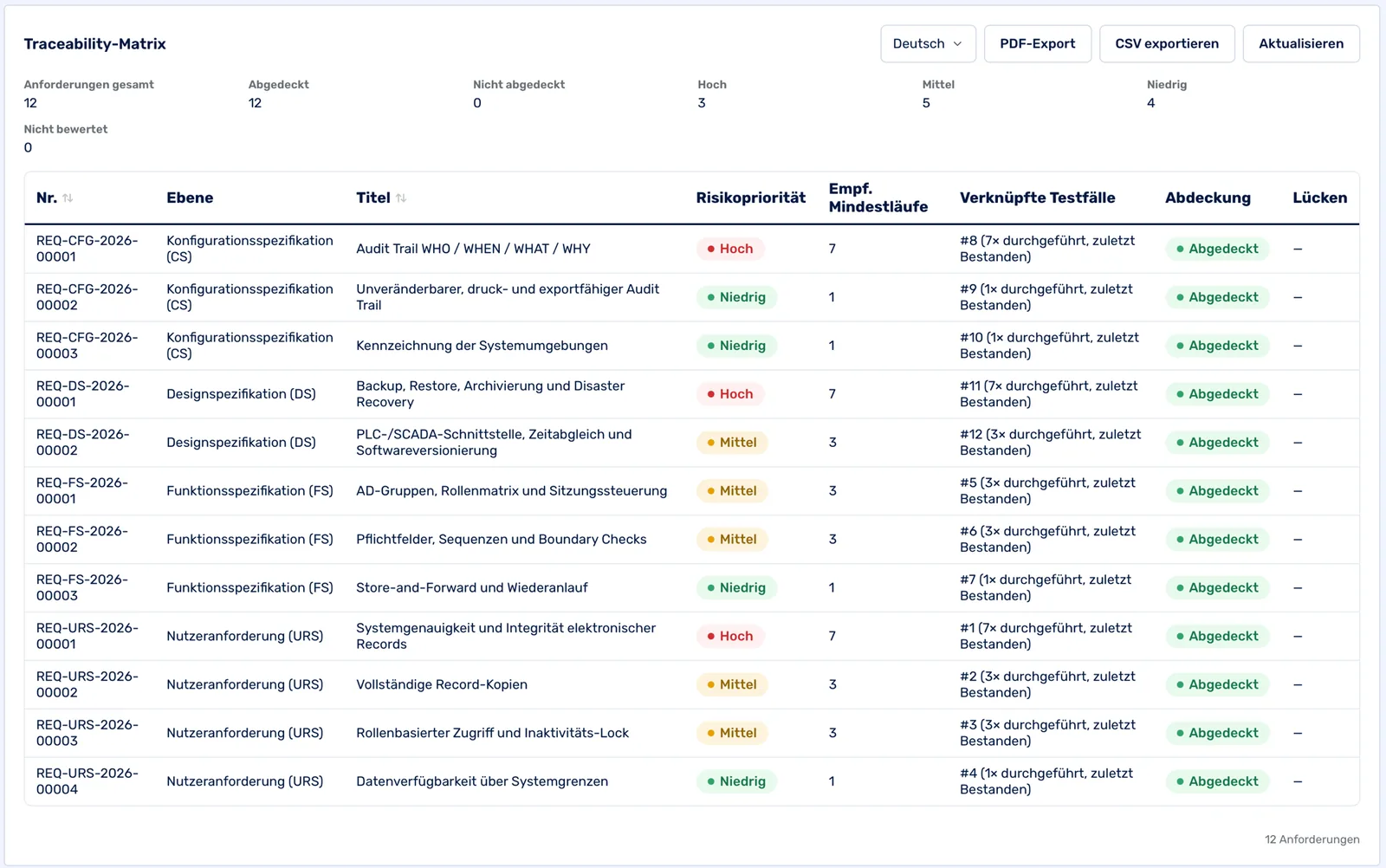
Specification on the left, evidence on the right: URS against PQ, functional specification against OQ, design specification against IQ. The traceability matrix shows every gap before the customer finds it.
- Traceability matrix as PDF and CSV so your customer can adopt it into their system
- Risk priority per requirement determines the minimum number of test runs
- Controls, SCADA and software of your machine as separate CSV plans
Example
Filter assembly: one requirement, one continuous chain of evidence
Requirement
“The system records force and travel when inserting the filter.” Criticality high, GxP-relevant. Adopted from the customer's URS with their ID.
Evidence at the supplier
DQ: sensors and recording confirmed in the design. FAT: test case with measurements from the test run, instrument calibrated, result signed.
Adoption by the customer
The customer adopts the FAT result into their OQ. The traceability matrix shows requirement, test case, execution, result, without a gap.
Your benefit
Why machine builders work with QV NOW
Qualification-ready documents
Your customer does not get a Word file but evidence their QMS can use directly. That shortens their commissioning and your acceptance.
Adoption into the customer's system
Traceability matrix and protocols come out as PDF/A and CSV. Your customer adopts them into their QMS even if they run different validation software.
One system for all projects
Every machine, every customer, every acceptance in the same system. Reusable requirement sets and test cases per machine type.
Also independent of the full workflow
Only the traceability matrix? Only the FAT protocol? Every module can be used on its own.
Onboarding in hours
Set up the first project together with us, then it runs. No implementation partner, no months.
A selling point
“Documentation qualification-ready per GAMP 5” then appears in your quotation, not only in the customer's specification.